
English version (machine translated) follows below.
Rien ne va plus
Raccontare storie è una delle forme più potenti di connessione tra le persone: lo storytelling è capace di coinvolgere, emozionare, offrire nuovi punti di vista e persino spingere chi ascolta ad ampliare la propria coscienza. Attraverso esempi concreti, frammenti veri, battute e cambi di registro, il racconto teatrale può trasformare il pubblico da semplice spettatore in parte attiva del viaggio narrativo. Ogni volta che si sale su un palco, si rinnova la possibilità di dare corpo a storie che non solo informano, ma che possono anche incidere sulla percezione individuale e collettiva.
Sarà la primavera, sarà che sono andata a vedere un paio di performance dal vivo, ma è tornata prepotente la voglia di salire sul palco. Proprio oggi, per caso (e sul caso avremmo da scrivere tanto, ma sarà per la prossima volta) mi è riapparso il link dello spettacolo “Rien ne va plus”, nato nel 2016 come parte del progetto Progetto “Punta su di te”. Scritto dagli stessi attori (Francesco Angelone, Marco Mucaria, Adriana Ribotta e la sottoscritta) coordinati da Grazia Isoardi di Voci Erranti, è stata una fantastica avventura.
Ci è stato chiesto uno spettacolo che trattasse il problema del Gioco Patologico, cercando però di essere (almeno in una prima parte) leggero, anche per catturare l’attenzione del pubblico delle scuole (secondarie di primo e secondo grado).
Siamo partiti da frammenti anonimi di storie vere, con l’aiuto di una psicologa, per poi scavare nelle motivazioni psicologiche che determinano il gioco, scoprire i numeri agghiaccianti del problema (e alcuni potrete sentirli nel video sotto) e infine, scoprire quanto malaffare si nasconde dietro al “sistema” del gioco con la complicità del nostro stato. Siamo andati in tabaccheria e al bingo per guardare movenze e tic dei giocatori. Da lì sono cominciati giorni di incontri, prove, improvvisazioni, scritture e riscritture testi. Ognuno di noi si è chiesto quale sarebbe stato il mezzo con cui più facilmente sarebbe “caduto in tentazione” e per quale motivazione. I nostri personaggi sono nati così, con un’analisi delle nostre debolezze o attitudini personali.
A poco a poco, abbiamo capito che il gioco patologico è un'epidemia. Una malattia nuova che contagia molti. Adolescenti, pensionati, disoccupati, liberi professionisti ed imprenditori, donne e uomini tutti alla ricerca dell'oro e di nuove sensazioni adrenaliniche per riempire la giornata. I nostri personaggi a poco per volta, prendono consapevolezza del dramma in cui si sono persi e non possono che fare i conti con i dati del fallimento, scoprendo di non essere più i protagonisti delle proprie vite, ma l'ingranaggio di un meccanismo malato e perverso.
Nel gioco si perdono affetti, patrimoni, relazioni, salute… e infine la libertà. Più nulla va, più nulla rimane.
E come finisce la nostra storia? Vi inviteremo alle prossime repliche… Nel frattempo, ecco a voi il link al trailer e al sito dell’associazione Voci Erranti.
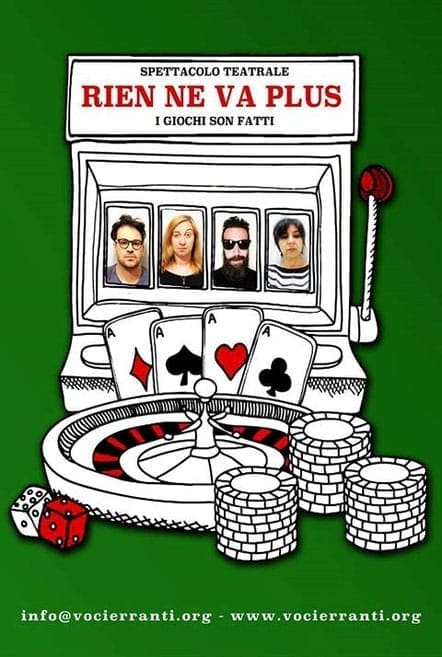
Rien ne va plus
Telling stories is one of the most powerful forms of connection among people: storytelling can engage, move, offer new perspectives, and even push listeners to expand their consciousness. Through concrete examples, true fragments, jokes, and changes of tone, theatrical storytelling can transform the audience from mere spectators into active participants of the narrative journey. Every time one steps onto a stage, the opportunity is renewed to give life to stories that not only inform but can also impact individual and collective perception.
It must be springtime, or maybe because I went to see a couple of live performances, but the urge to get on stage has come back strong. Just today, by chance (and we could write a lot about chance, but that will be for next time), the link to the play “Rien ne va plus”, which was born in 2016 as part of the project “Punta su di te”, reappeared to me.
Written by the actors themselves (Francesco Angelone, Marco Mucaria, Adriana Ribotta, and myself) coordinated by Grazia Isoardi of Voci Erranti, it was a fantastic adventure.
We were asked to create a show addressing the problem of pathological gambling, trying to keep it (at least in the first part) light, also to capture the attention of school audiences (middle and high schools). We started from anonymous fragments of true stories, with the help of a psychologist, then delved into the psychological motivations driving gambling, discovered the chilling numbers of the problem (some you can hear in the video below), and finally uncovered how much crime is hidden behind the gambling “system” with the complicity of our state. We visited tobacco shops and bingo halls to observe the gestures and tics of gamblers. From there started days of meetings, rehearsals, improvisations, writing and rewriting texts. Each of us asked ourselves what would be the means by which we would most easily “fall into temptation” and for what reason. Our characters were born this way, from an analysis of our personal weaknesses or attitudes.
Little by little, we understood that pathological gambling is an epidemic. A new disease that infects many. Teenagers, retirees, unemployed people, freelancers and entrepreneurs, women and men all looking for gold and new adrenaline sensations to fill the day. Our characters gradually become aware of the drama they are lost in and can only face the facts of failure, discovering they are no longer the protagonists of their own lives but the cog in a sick and perverse mechanism.
In gambling, affections, possessions, relationships, health... and finally freedom are lost. The more everything goes wrong, the less remains.
And how does our story end? We will invite you to the next performances... Meanwhile, here is the link to the trailer and to the website of the Voci Erranti association..
Cosa ti fa venire in mente questo post?
YOU MIGHT ALSO LIKE
Ti incuriosiscono i bias cognitivi? Scarica la mia guida gratuita e scopri i piccoli sabotatori delle tue decisioni. Non mi devi neanche lasciare la tua mail, tranquill*
Privacy policy: https://www.iubenda.com/privacy-policy/31240018
Cookie Policy: https://www.iubenda.com/privacy-policy/31240018/cookie-policy
Creato con ©systeme.io